
General Equipment Guidelines for Ultrasonic Cleaners
Thousands of ultrasonic cleaners are in use every day in a variety of industries to clean everything from automotive engine parts to high technology hardware such as missile guidance systems and satellite components. However, most engineers that contact Zenith have very little information at their disposal on what is required for a system to meet the requirements of a particular application, or what makes one system better than another. The intent of the following general equipment guidelines is the provide you with some basic information regarding how a process is developed for a particular cleaning application.
One of the biggest problems is the fact that engineers are not taught ultrasonic cleaning technology in college, and we are not aware of a single institution where this technology is taught as a course in a university or college. This leaves the engineer reliant upon the honesty and experience of the ultrasonic cleaner vendor to provide them with the information they need to purchase the perfect machine for their application, not the best scenario to say the least. It is our intention to provide you with some information herein to guide you in making decisions regarding how to select the best ultrasonic cleaner for your use and then optimize it for a particular application.
Aqueous Cleaner Processing Steps
All aqueous ultrasonic cleaners must include the following 3 processing stages:
- Ultrasonic Cleaning: In this tank or series of tanks, the contaminants are removed using a low-concentration mixture of detergent and water.
- Rinsing: Once the parts have been cleaned, they will be covered with detergents which must be removed from the parts.
- Drying: After rinsing, parts are covered in water and this water must typically be removed to complete the process.
For a complete process, an ultrasonic cleaning system must include a series of tanks that include the above processes. Typically, there will be a single cleaning tank, 2 rinsing tanks, and a single drying tank. However, your needs may not require drying, or may require a rust preventative dipping tank or additional rinsing tanks. See our multi-stage cleaning systems page for additional information on multi-tank systems. Parts will be transferred from tank to tank by hand or automatically using automation systems such as our Advantage or Transtar systems.
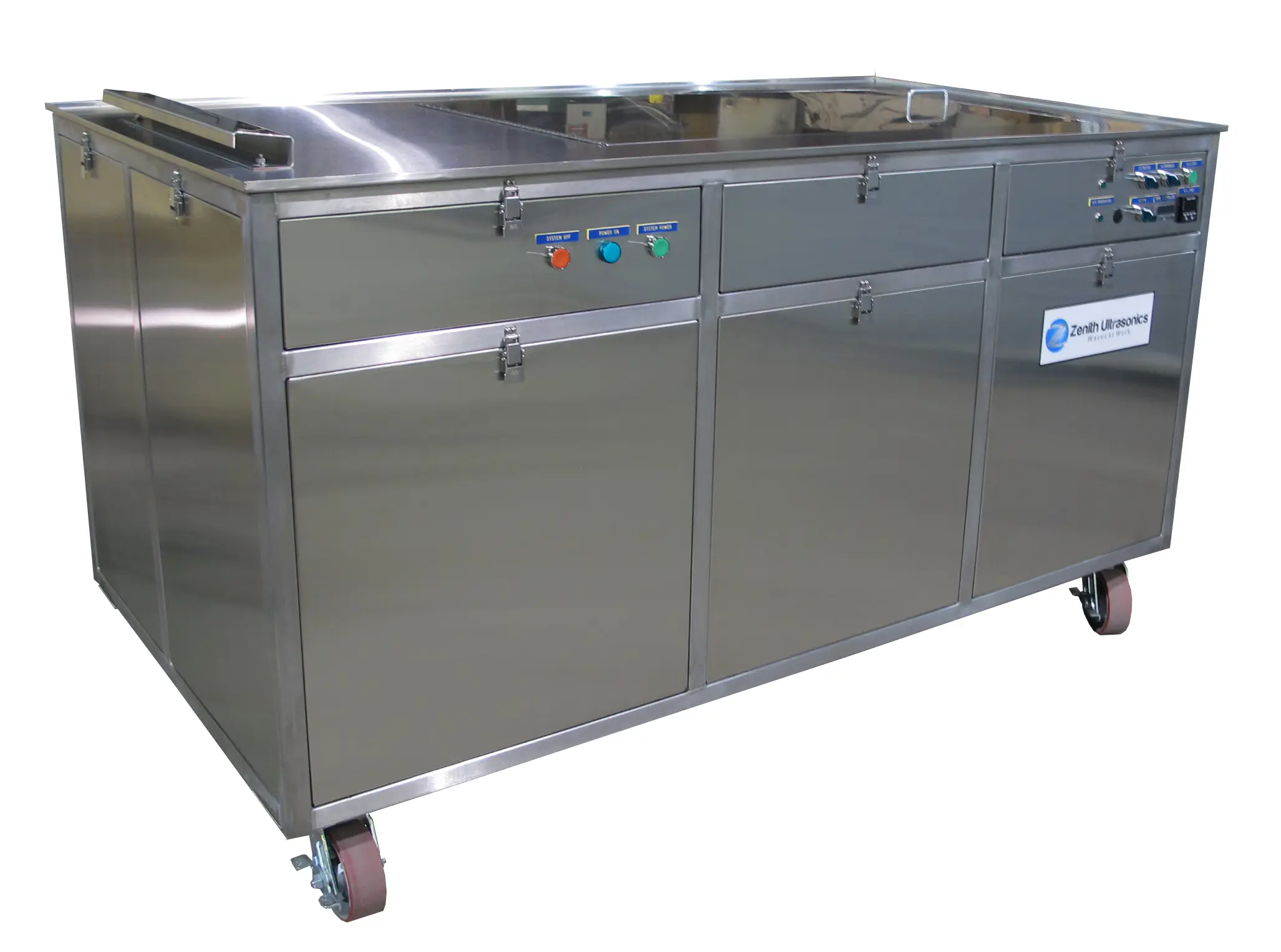
There are instances where companies already have rinsing and drying operations that can be used and in these cases, a single-tank console or table-top ultrasonic cleaner can be purchased rather than a complete multi-tank cleaning system.
Determining the Number of Tanks Required
The number of ultrasonic cleaning tanks that are required are determined by a few factors:
- The volume of parts being cleaned: If batch after batch of parts are being cleaned on a nearly continuous basis, 2 ultrasonic cleaning tanks may be required, the first being used to clean the majority of contamination, the 2nd to clean the balance.
- When more than 1 cleaning fluid is required: In some cases, one cleaning fluid cannot be used to clean all product. The first tank might be used for steel parts and the 2nd tank for aluminum parts.
- The speed at which you wish to clean: If parts require a total of 10 minutes of cleaning time, you could purchase 2 ultrasonic cleaning tanks and transfer baskets after 5 minutes. This allows the system to double its throughput.
- When multiple operating frequencies are required: If 2 ultrasonic cleaning tanks are included, the first might include a 25/40kHz Crossfire system, while the 2nd might include 40/80kHz Crossfire for the cleaning of more sensitive parts.
How Many Rinse Tanks do I Need?
Regardless of the number of rinse tanks included, it is the FINAL rinsing tank which is most important. The quality of the final rinse tank just before the drying process will largely determine the quality of the cleaning result. The number of rinsing tanks required for your ultrasonic cleaner are determined by the following factors:
- The volume of parts being cleaned: The greater the volume of parts being cleaned each day, the greater the number of rinsing tanks which will be needed to maintain the quality in the final rinse tank. The reason for this is that each time a basket is transferred from the ultrasonic cleaning tank to the first rinsing tank, detergents are also transferred and these detergents begin to build up in the rinse tanks.
- The design of the parts being cleaned: If parts being cleaned have blind holes or other details which tend to trap liquids, more detergent will be transferred into the rinsing tanks with each basket load, thereby contaminating the rinse water faster.
- The detergent concentration: The greater the detergent concentration in the cleaning tank, the faster the rinse water will be contaminated with detergents when baskets are transferred.
- Water conservation requirements: The greater the number of rinsing tanks, the less water you will need to maintain the water quality in the final rinse tank.
All of the above factors must be considered to ensure that the proper number of rinsing tanks are included in your ultrasonic cleaner. In the vast majority of applications, a minimum of 2 rinsing tanks which share the same water supply can be used. Fresh water is added to the final rinse tank which overflows into the first rinse tank, thereby ensuring that the final rinse tank has the purest water available while simultaneously reducing water consumption since both tanks share the same water supply. If only one rinse tank is used, it will rapidly become diluted cleaning fluid and parts will have detergent residues on them after drying. This, however, may be acceptable for some applications where final cleaning will take place later.
What is a “Drying Bottleneck?”
In a large number of applications, the drying is a bottleneck that slows the entire process down. Drying duration commonly exceed those in the cleaning and rinsing tanks. As such, the drying time will determine the basket processing rate of the cleaning system. The ejection rate of a multi-stage ultrasonic cleaner is determined by the duration of the longest processing stage. To increase the basket ejection rate of the cleaning system:
- Use high-volume blowers in the drying tank: By increasing the airflow, parts drying will take place at a faster rate.
- Increase drying tank temperatures above the boiling point
- Include multiple drying tanks: If parts require 10 minutes to dry and 2 drying tanks are included, the basket ejection rate will be only 5 minutes rather than 10 minutes since baskets can transfer to the next tank every 5 minutes.
- Include a drying tunnel: A drying tunnel accomplishes the same thing as multiple drying tanks; many baskets are dried simultaneously. Our Aeroclean High-volume Aerospace Parts Washer includes such a drying tunnel to increase basket ejection rates.
- Adjust part positioning in the basket: To decrease drying times, puddles of any kind on the parts should be avoided. This may require that parts be positioned in a specific orientation to shed water when lifted from liquid tanks. Not only will this improve drying times but will also decrease the amount of detergent which will be dragged into the rinse water thereby reducing rinse water consumption.
- Blow off excess liquids with compressed air: Air-knives or hand-operated air wands are very effective at removing liquids from parts and can drastically reduce drying times.
- Increase final rinse tank temperatures: By increasing the temperature in the final rinse tank, parts will enter the drying tank pre-heated to higher temperatures which reduces the amount of time it will take for the parts to reach drying tank temperatures.
The Perfect Ultrasonic Cleaner
As you can see, the perfect ultrasonic cleaner for your particular application must take many things into account. The number of cleaning tanks to use, ultrasonic frequencies selected, the number of rinsing and drying tanks, processing temperatures, and many other factors must be considered. In addition to these considerations, there are other issues such as detergent selection and concentration, waste disposal methods, rinse water quality and control methods, cavitational erosion concerns, filtration, detergent monitoring, and others which must also be considered. Having more experience than any other ultrasonic cleaner manufacturer in the world, Zenith is uniquely qualified to evaluate your particular application and make recommendations for equipment which will meet your processing requirements and budget.
